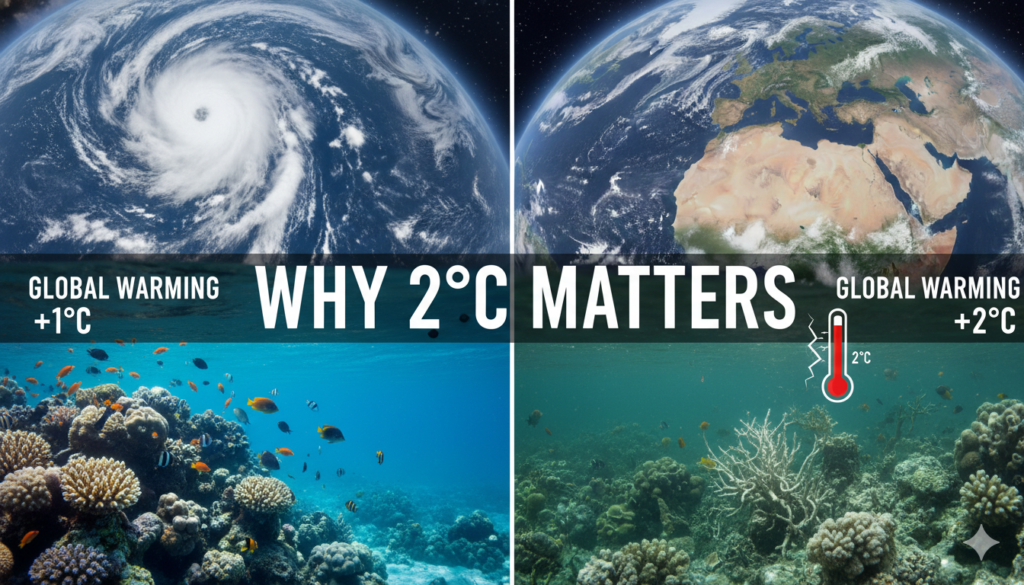

Have you ever wondered why scientists keep talking about a tiny number like 2 Degrees? It might seem like nothing. After all, if the weather outside changes by 2 degrees, you probably won’t even change your sweater! But when we talk about the entire planet, 2 degrees is a massive deal. It is like the difference between a person having a normal day and a person having a fever. Our Earth is very sensitive to these small shifts in heat. In this article, we will explore why keeping our world from warming up by 2 Degrees is the most important goal for humanity right now. We will look at how it changes the ice, the oceans, and even the food on your dinner table.
Climate Change at a Glance
| Feature | Details |
| Main Goal | Keeping global warming well below 2 degrees |
| Key Agreement | The Paris Agreement (2015) |
| Current Status | Earth has already warmed about 1.1 degrees |
| Biggest Factor | Greenhouse gas emissions (CO2 and Methane) |
| Main Impact | Rising sea levels and extreme weather |
What Does 2 Degrees Mean for the Planet?
When people talk about 2 degrees, they are usually referring to the average temperature of the whole world. Since the time of big factories, humans have been burning coal and oil. This creates a blanket of gas around the Earth. This blanket traps heat. If that blanket gets too thick, the world warms up by 2 degrees. While 2 degrees sounds small, it acts like a giant engine for storms. It makes the hot days much hotter and the wet days much wetter. Scientists say that crossing this line could lead to changes that we cannot fix. It is the “tipping point” where nature starts to struggle to keep up with the heat.
Shutterstock
Explore
Converting 2 Degrees C to F
If you live in the United States, you might be confused by the Celsius scale. You might ask, “What is 2 degrees c to f?” To understand the impact, we have to look at the conversion. A change of 2 degrees Celsius is actually equal to a change of 3.6 degrees Fahrenheit. That is a much bigger jump! When the whole world gets 3.6 degrees warmer on average, the hottest days in the summer can spike by 10 or 12 degrees. Understanding 2 degrees c to f helps us see why the math matters so much for our gardens and our health.
Why 1.5 Degrees is Better Than 2 Degrees
There is a big debate about whether we should stop at 1.5 degrees or 2 degrees. You might think half a degree isn’t much, but it saves millions of lives. At 1.5 degrees, some coral reefs might survive. At 2 degrees, almost all the coral reefs in the ocean will die. That is a huge loss for the fish that live there. Also, at 2 degrees, the sea level rises much higher than it does at 1.5. This means more people living near the beach would have to move their homes. Keeping the warming lower than 2 degrees is like choosing a small puddle over a giant flood.
How 2 Degrees Affects Our Oceans
The ocean is like a giant sponge that soaks up heat. But even a sponge has a limit. When the world warms by 2 degrees, the water in the ocean expands. This is a basic rule of science: warm things take up more space. This causes the sea level to rise. Plus, the giant ice sheets in places like Greenland start to melt. If we hit 2 degrees of warming, many islands could disappear underwater. It also makes the water more acidic, which is bad for clams and oysters. Our beautiful blue oceans are the first to feel the sting of those 2 degrees.
Shutterstock
The Impact of 2 Degrees on Our Food
We all like to eat, but a warming world makes farming very hard. Crops like corn, wheat, and rice do not like to be too hot. If the planet hits 2 degrees of warming, farmers will have a much harder time growing food. Some places will have too many droughts, meaning no rain for the plants. Other places will have too much rain, which washes the seeds away. We might see food prices go up because there is less to go around. To keep our plates full, we must work hard to stay below that 2 degrees limit.
Extreme Weather and 2 Degrees
Have you noticed more big storms lately? That is partly because of the extra heat. A 2 degrees warmer world holds more moisture in the air. This moisture turns into massive rainstorms and hurricanes. On the flip side, the extra heat dries out the ground in other places, leading to wildfires. I remember seeing news about fires that lasted for months; that is what happens when we let the thermometer climb toward 2 degrees. It makes the weather unpredictable and dangerous for everyone, no matter where they live.
Animals and 2 Degrees of Change
Animals cannot turn on an air conditioner when they get hot. They have to move or adapt. If the world warms by 2 degrees, many animals will lose their homes. Polar bears need ice to hunt, but that ice is melting fast. Many birds might fly to new places only to find there is no food waiting for them. Scientists worry that many species will go extinct if we reach 2 degrees. We share this planet with millions of amazing creatures, and protecting them means keeping the world cool and stable for their survival.
What Can We Do to Stop 2 Degrees?
The good news is that we still have time! To stop the world from reaching 2 degrees, we need to use cleaner energy. This means using the sun and the wind to make electricity instead of burning coal. We can also plant more trees, which breathe in the gases that cause warming. On a smaller level, you can help by using less energy at home or walking instead of driving. Every little bit helps us stay away from that 2 degrees mark. It is a team effort that involves every person on the planet working together for a better future.
The Paris Agreement and the 2 Degrees Goal
Back in 2015, almost every country in the world met in France to sign a big promise. This is called the Paris Agreement. They all agreed that we must keep global warming “well below” 2 degrees. They knew that hitting that number would be a disaster for kids growing up today. They set a goal to try and stay at 1.5 degrees if possible. This agreement is like a giant chore chart for the whole world. It lists what every country needs to do to keep the air clean and the temperature low.
A Future Beyond 2 Degrees
What happens if we don’t stop at 2 degrees? If we keep going to 3 or 4 degrees, the world will look very different. Some places might become too hot for people to live at all. This is why the 2 degrees limit is so famous. It is our line in the sand. By focusing on this goal, we can build a world that is green, healthy, and safe. Imagine cities with electric buses, parks on every corner, and clean air. That is the world we get if we respect the power of those 2 degrees.
Frequently Asked Questions
- Is 2 degrees really that much? Yes, for the whole planet, it is huge. It changes how the entire Earth functions, from the winds to the deep oceans.
- What is 2 degrees c to f? It is a change of 3.6 degrees Fahrenheit. This is enough to change local climates forever.
- Has the Earth warmed up already? Yes, the Earth has already warmed by about 1.1 degrees Celsius since the late 1800s.
- Can we still stop at 2 degrees? Yes! If we switch to clean energy quickly and protect our forests, we can stay below this limit.
- Who is most affected by 2 degrees? People living on islands and poor countries often feel the effects of heat and rising seas first.
- Do trees help stop 2 degrees of warming? Absolutely. Trees soak up carbon dioxide, which is the main gas that traps heat in our atmosphere.
Conclusion: Every Degree Counts
In the end, 2 degrees is more than just a number on a chart. It represents the health of our home. We have seen how it affects our water, our food, and the animals we love. While the challenge seems big, the solution is in our hands. By understanding things like 2 degrees c to f and the science of climate change, we are better prepared to make good choices. Let’s work together to keep the Earth cool and thriving for generations to come.